
Affiliate disclosure: Kangglow may earn a commission if you buy through a marked link on this page.
Choose the Zendure SolarFlow 2400 Pro if you want to connect new solar panels directly to the battery system. If you already have solar and want to keep your existing inverter, start with the SolarFlow 2400 AC+. Both units store a nominal 2.4 kWh. The choice comes down to how solar power reaches the battery.
SolarFlow 2400 Pro and 2400 AC+ compared
| Feature | SolarFlow 2400 Pro | SolarFlow 2400 AC+ |
|---|---|---|
| Typical use | Connect new panels directly, either on their own or alongside existing solar | Add battery storage to an existing solar installation |
| Solar charging paths | Direct DC input and AC coupling | AC coupling via the existing inverter |
| Direct solar input | Four MPPT inputs, up to 3,000 W combined per the spec sheet | None |
| Rated grid-connected AC output | 800 W in Standard mode, 2,400 W in Premium mode | 800 W in Standard mode, 2,400 W in Premium mode |
| Built-in battery | 2.4 kWh nominal, LiFePO₄ | 2.4 kWh nominal, LiFePO₄ |
| Battery expansion | Up to 16.8 kWh with five AB3000L batteries | Up to 16.8 kWh with five AB3000L batteries |
| Weight and enclosure rating | 27.8 kg base unit, IP65 | 27.8 kg base unit, IP65 |
These are Zendure’s specifications for the German models ZDSF2400P and ZDSF2400AC+, checked on 20 November 2026. The output permitted for your installation depends on its connection and how the system is classified.
SolarFlow 2400 Pro for new or additional panels
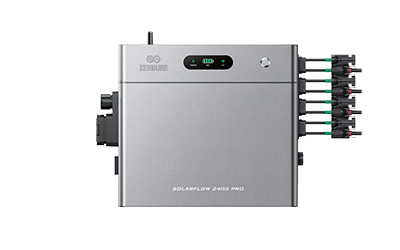
Each of the four MPPT inputs tracks panel output independently. That can help when panels face different directions. An east-facing panel and a west-facing panel, for example, peak at different times of day. Before ordering, check your panels against the input voltage and current limits or compare the complete kits Zendure offers.
The Pro can also charge over AC. That makes sense if you already have rooftop solar and want to connect more panels directly to the battery. The 3,000 W figure is the technical input limit for direct solar. When sizing the array, account for the rules that apply to your installation, which direction the panels face, and how much room you have.
SolarFlow 2400 AC+ for an existing solar array
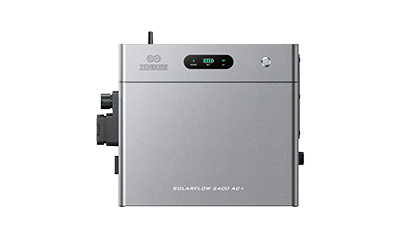
Your panels stay connected to the inverter you already have. The inverter converts their output to AC, and the AC+ stores surplus energy for later use. This setup fits a household that wants to keep its rooftop system and use more of the day’s generation after sunset.
Automatic charging and discharging based on household consumption depends on compatible metering. Check which smart meter works with your system and whether it comes with the kit. If you already have a battery or an export limit, ask your installer how the controls will work together.
How Germany’s 800 VA limit affects the choice
Germany’s Federal Network Agency lists limits of 2,000 W of installed panel capacity and 800 VA of inverter output for the simplified plug-in solar rules under the Renewable Energy Sources Act (EEG). Eligibility also requires that exported electricity is supplied without payment. The agency uses the highest selectable output to assess the inverter limit, so a lower setting in the app alone does not qualify a system for the simplified rules.
Confirm the connection and registration requirements with your grid operator or a qualified electrician, especially if you are adding storage to an existing array or plan to use the 2,400 W mode. Have a qualified electrician handle any hardwired connection.
Is 2.4 kWh enough?
Each AB3000L adds 2.88 kWh of nominal capacity. One brings the total to 5.28 kWh, two to 8.16 kWh, and five to 16.8 kWh. Reserves and conversion losses reduce the energy available to your appliances. Check the exact battery model before ordering.
Check how much energy you regularly export during the day and how much you buy back in the evening or overnight. Where available, use the figures from your meter portal or inverter app. If you typically export about 1 kWh a day, a 5.28 kWh setup will have a lot of spare capacity. An extra battery makes more sense when you regularly have several kilowatt-hours of surplus and enough evening demand to use it. Compare a few weeks in spring and autumn, too. A clear day in July can make a large battery look more useful than it will be across the year.
When comparing prices, include the compatible meter, any expansion batteries you actually need, and the cost of connecting the system. If your existing inverter already supplies all the solar power you want to store, the AC+ gives you the same base capacity and expansion options as the Pro.

